
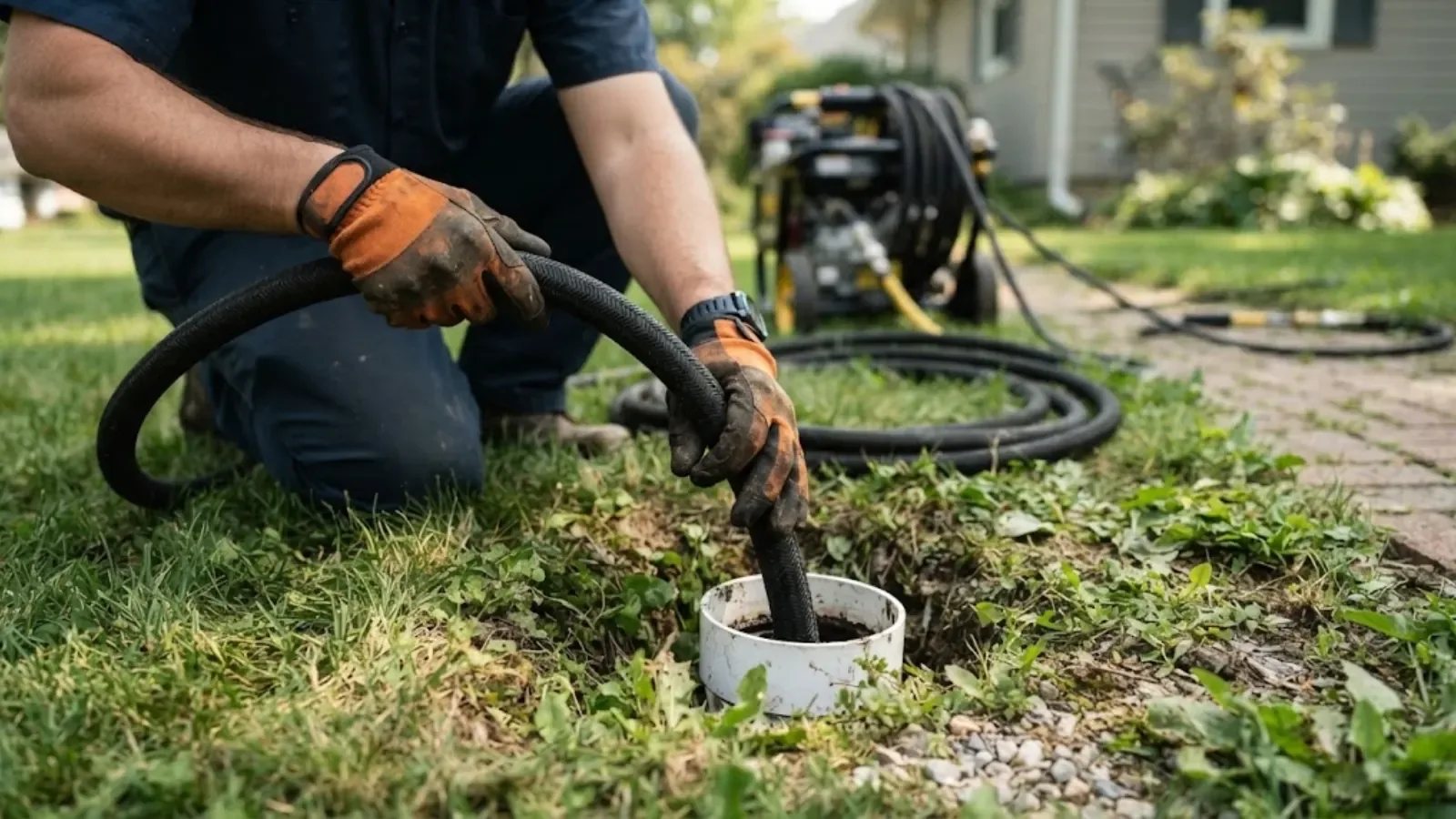
What an underground gutter drain is
Many homes send roof water through downspouts into a buried pipe. That pipe carries the water out to a lower part of the yard, a curb outlet, a storm inlet or a pop-up emitter. It is out of sight, so it often goes unmaintained for years.
Leaves, shingle grit, seeds and mud wash down and settle in the low points. Over time the pipe packs tight. Roots can also work into joints.
When it clogs, water backs up in the gutter, spills over the edge and soaks the soil along the foundation. That is one of the common causes of wet basements after a storm. Cleaning the buried line is a low-cost way to cut the risk.
Signs your buried gutter line is blocked
You do not need a camera to spot a problem. Watch for these clues during the next rain.
Warning signs
- Water overflows the gutter even though the gutter itself is clean.
- The downspout fills and drains very slowly, or gurgles.
- A wet or sunken patch in the lawn over the pipe route.
- Water pooling beside the foundation under a downspout.
- Muddy water or debris at the outlet when it finally runs.
- A pop-up emitter that stays closed and never opens.
If you only see one of these, a cleaning may be enough. Several together, or a basement leak that lines up with a downspout, may mean the pipe is cracked or collapsed. Our leak detection page covers finding hidden water problems.
Tools and safety
You need a garden hose with a spray nozzle, work gloves, safety glasses and a bucket. A small drum snake, around 15 to 25 feet, helps with packed leaves. A wet and dry vacuum can pull debris from an open drain cap.
Use a stable ladder on firm, level ground, and have someone hold it. Do not climb onto a roof or lean a ladder on a gutter. Stay far away from overhead power lines at the service drop. If the work is above a second story, hire a pro.
Never use a pressure washer wand with a hard nozzle inside an old pipe. It can split clay or thin plastic. And do not put your hands into a pipe opening where a spade or wire could slip.
Step by step: flushing the line
Work in dry weather so you can see how the water moves. Plan for 30 to 60 minutes per downspout.
- Clean the gutter above the downspout and pull any debris out by hand.
- Detach the downspout elbow where it enters the ground, if it comes off easily.
- Look into the pipe with a flashlight. Scoop out leaves and mud by hand with gloves on.
- Push the garden hose in a few feet and run the water at medium pressure.
- Feed the hose in further as the water clears the blockage, and keep an eye on the outlet.
- If the flow is slow, run a small drum snake in gently and pull back the debris.
- Flush again until the water runs clear and the outlet drains fast.
Watch where the water comes out. If it appears at the outlet within a minute, the pipe is clear. If it never shows, or shows up in a surprise spot like a basement floor, stop and call a plumber.
What the Village expects of buried pipes
Village rules for buried downspout and sump pipes
The Village of Hoffman Estates permit handout on drainage says private underground piping that takes sump pump or downspout water needs an air gap per the Village detail, a minimum 4 inch pipe diameter and 18 inches of bury. Under Municode Section 11-3-2, footing drains may not connect to the sanitary sewer, and the sump discharge rule tells you to send storm water to the storm sewer or a ditch or swale.
For you, that means a repair or reroute should keep the water in storm piping, never in the sanitary line. If you find a downspout pipe that appears to join the sewer service line, do not guess. Call a plumber and ask Village Engineering at 847-252-5800.
The standard behind those rules is Municode Section 11-3-2, so a reroute is judged against it and not against whatever drains fastest.
If the problem is the street side, such as a blocked catch basin or flooding in the road, call Village Public Works at 847-490-6800 (Monday to Friday, 8 to 4). After hours, the Village lists the Police number 847-882-1818 for flooding and blockage.
How to tell if the flush worked
Run the hose into the downspout for a full minute with the outlet in view. Clear water at the outlet in under a minute is a good sign. Then wait for the next rain and watch the downspout. It should empty steadily with no gurgling and no pooling at the base.
If you cannot tell, call (630) 822-9290 and describe what you saw. A short description of where the water exits often tells a plumber whether the pipe is open, partly blocked or broken.
Mistakes to avoid
Do not pour chemical drain cleaner into a downspout line. It does little against leaves and mud, and it is hard on pipe joints and the soil. Do not run a snake hard against a stop. You may punch through a loose joint.
Do not connect a downspout line to the house drain to "get rid of the water." That sends rain into the sanitary system and can flood a basement. It also breaks the Village code on keeping storm water out of the sewer.
And do not dig up the yard to find the pipe by guesswork. Gas, water, electric and communication lines run in many yards. Before any digging, call 811, the Illinois one-call line. The Village's own water service handout lists J.U.L.I.E. 811 for work that involves buried utilities.
When to call a plumber
A plumber is worth the call when:
- The hose cannot pass a certain point and the water backs up.
- You find roots or a crushed section when you look in.
- Water appears in the basement while the downspout is flowing.
- The route is long, has several bends or joins a sump line.
- The same downspout clogs again within a season.
- You suspect the downspout drain ties into the sewer.
A pro can run a camera through the line and show where it is blocked or broken. Our sewer camera inspection service uses the same kind of camera for underground pipes. If the pipe is full of packed material or roots, drain cleaning with a machine usually clears it.
We also cover the Schaumburg side. If you are east of the village line, our Schaumburg plumbing page lists what we offer there. Call (630) 822-9290 if you want a plumber to look at a buried line.
Once a year is a good habit, and again after a heavy leaf season. If you have big trees near the roof, check twice. Run water through the line to confirm it still flows.
The Village allows sump pump and downspout connections to underground piping, but the pipe needs an air gap per the Village detail, a 4 inch minimum diameter and 18 inches of bury. Check with Village Engineering before you reroute anything.
Call Village of Hoffman Estates Public Works at 847-490-6800 on weekdays. The Village maintains the storm sewer and its catch basins and inlets, and gives an after hours police number for flooding.
Not a hard nozzle. High pressure can split old clay or thin plastic pipe. Use a garden hose first.
It may be a blocked or broken gutter line, or it may be groundwater. A plumber can check the sump and the line together.