
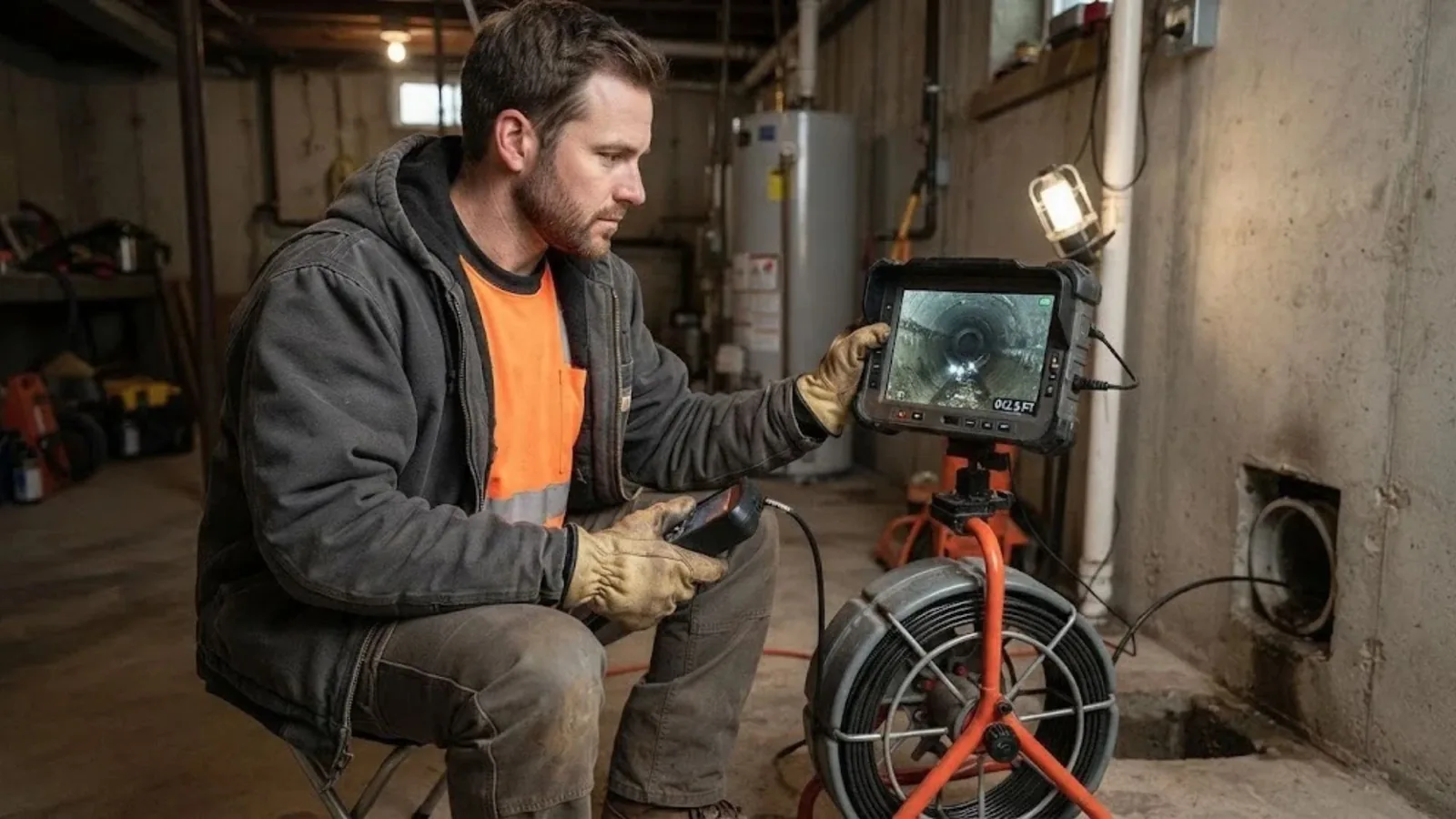
What a sewer camera inspection actually shows
A sewer camera is a waterproof lens on a flexible cable. It feeds live video to a screen as it moves through the pipe. A transmitter in the head lets a locator above ground follow its position, and the cable's length markings give the distance to anything we see.
That combination answers the questions that matter. Is the pipe cracked, offset or collapsed? Are roots growing in at a joint? Is a section sagging and holding water? Or is the line sound and the clog just grease? Without a camera, those are guesses. With one, you can point at the screen.
For a homeowner, the value is avoiding the wrong repair. A pipe that is fine does not need replacement, and a pipe that is failing should not be cleaned again and again. Call (630) 822-9290
When an inspection is worth doing
Not every slow drain needs a camera. These situations usually do.
Good reasons to scope the line
- A clog returns after cabling or jetting.
- More than one fixture backs up, or a floor drain smells.
- A cable stops at the same distance each time.
- You are buying a home with an older or unknown sewer line.
- A wet patch or sinking soil appears along the line to the street.
- You are planning a remodel, addition or landscaping over the pipe.
If your drains are working now and nothing has changed, an inspection is optional. For a house you are about to buy, it can be one of the more useful checks before closing, since the sewer line is one of the costly parts of a home you cannot otherwise see.
How the visit works
- We find a cleanout or another access point. If the line has none, we tell you how we will get in.
- We clear any debris that would block the lens, because a camera cannot see through a full pipe.
- The camera goes in and travels toward the street while we watch the screen.
- We note each defect, its distance and its type, and the locator marks the surface position.
- We review the video with you and explain which findings matter and which do not.
A clear line goes quickly. A line with a heavy blockage takes longer because it needs cleaning first. Our 24/7 phone line also takes calls for urgent backups, so if your drain is overflowing, say so when you call (630) 822-9290 and we will treat it as a priority.
What the video can find
| What the camera shows | What it usually means | Typical next step |
|---|---|---|
| Clean pipe, steady flow | The clog was temporary | Cleaning habits |
| Grease or scale coating | Narrowed line | Hydro jetting |
| Roots at a joint | Open joint | Root cutting, then repair planning |
| Cracked or broken pipe | Failed section | Spot repair or lining |
| Belly or sag | Low point holds waste | Repair or replacement |
| Offset joint | Pipe sections have shifted | Repair at the joint |
Nothing on this list is a surprise to us, and none of it should be a surprise to you. We show you each finding on the video and explain the choices. If the line only needs cleaning, our sewer line cleaning page covers that work. If it needs a fix, sewer line repair explains the options.
According to the Village's sewer repair handout, a building drain within 5 feet of the foundation is Schedule 40 PVC and the building sewer outside it is SDR 26. The pipe material the camera identifies tells you whether a repair would have to meet that standard.
Buying or selling a home
A sewer line is buried and out of sight, so buyers often learn about problems after closing. A camera inspection before you buy gives you a recording of the pipe's condition on that day. You can use it to negotiate a repair, ask for a credit or walk away with full information.
Sellers use inspections too. Knowing the line is sound removes a point of doubt, and finding a problem early lets you fix it on your schedule. We provide the video and a plain explanation, and you decide who sees it. Call (630) 822-9290
Older homes, the Village main and the camera
Hoffman Estates began with a 1954 subdivision called Parcel A, east of Roselle Road between Golf and Higgins, and grew fast through the 1960s and 1970s. Homes from those decades have had sewer lines in the ground for a long time. Age is not a defect, but it is a good reason to look before you commit to a purchase or a remodel.
Responsibility matters too. The Village maintains the sanitary mains, and the homeowner is responsible for the service line from the house up to and including the connection to the main. A camera shows whether a defect sits on your side of that connection. The Village inspects sewer repairs before the pipe is covered, and your video documents the condition beforehand.
Locating the line and marking the spot
If the video shows a break, the locator pinpoints it on the surface. We mark the position and depth so a repair can start with a small, accurate excavation, and not a wide trench. This also helps you plan around patios, driveways and trees, and it supports a trenchless option when the pipe allows.
We cover homes across Hoffman Estates and nearby Schaumburg. Whichever side of the line you live on, the process is the same. (630) 822-9290
What changes the price of a sewer camera inspection
We give you the price by phone before the visit, and we tell you if the pipe needs cleaning first. You decide whether to proceed. Call (630) 822-9290
A clear line with easy access is usually a short visit. A line that needs cleaning first takes longer, and we tell you when you call.
It helps a great deal. Without one, we may need to pull a toilet or use another opening, and we explain the options before we start.
Yes. The locator marks the surface position and depth of the defect, so any excavation is small and accurate.
We can save the recording and walk you through it. It is useful for a purchase, a repair decision or an insurance conversation.
Often yes. Hoffman Estates has homes dating back to the 1950s, and the sewer line is expensive to fix and impossible to judge by eye.
Call (630) 822-9290 and say so. Backups are handled as urgent, and we can clear the line first and scope it after.