
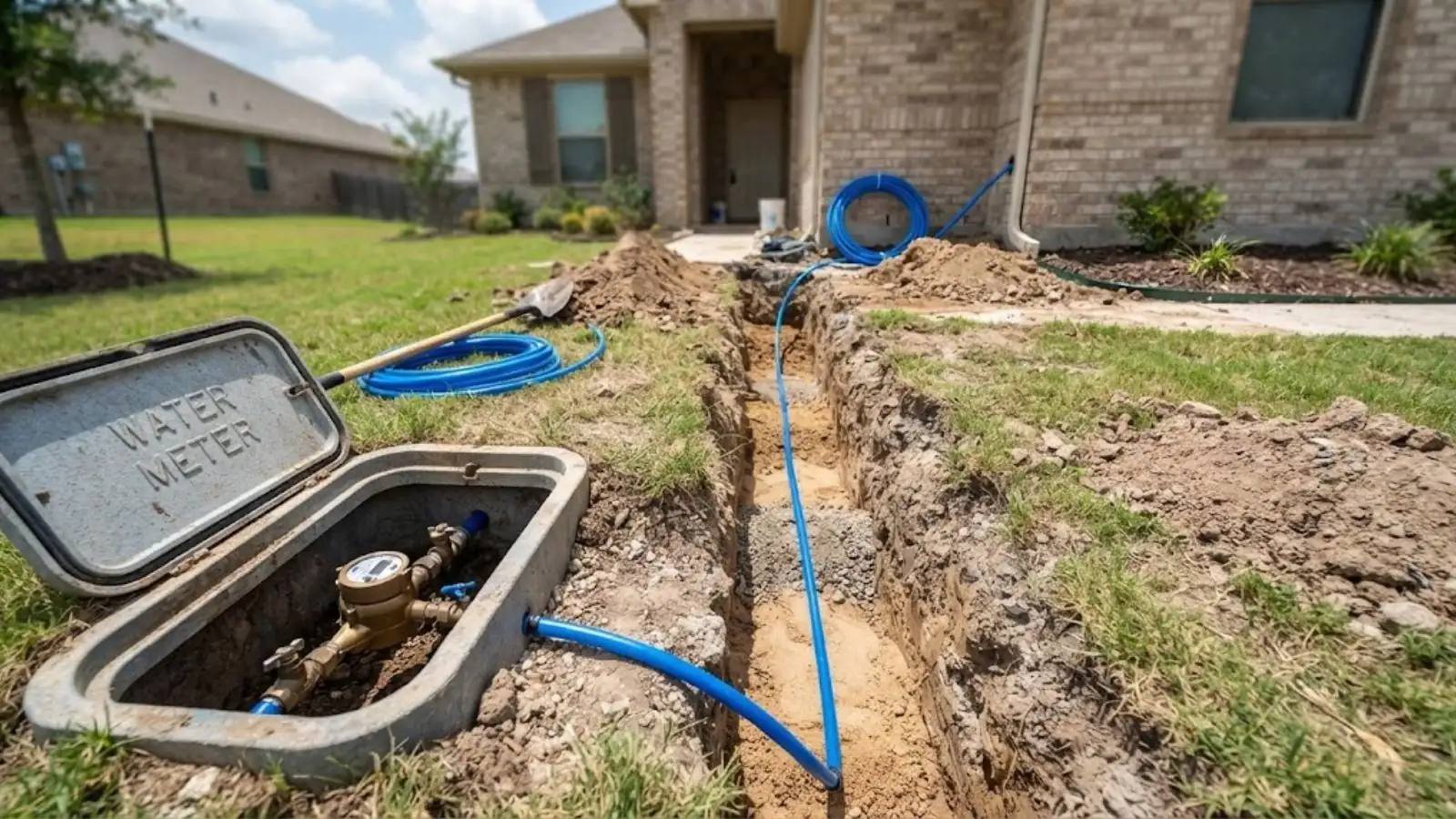
First steps when the service line fails
A broken water service line behaves differently from a burst pipe inside the house. The water often leaves through the soil, so the first sign may be a sinking patch of yard or a basement that smells damp. Start with these steps.
What to do right now
- Close the main shutoff valve inside the house, usually near the meter.
- If the valve will not close, call Hoffman Estates Public Works at 847-490-6800 about the street shutoff, then call us.
- Keep people and pets away from a washed-out or sinking area of lawn.
- Stay out of a wet basement if water is near outlets or the panel, and call 911 if you feel unsafe.
- Take photos of the wet area and the meter reading for your records.
Do not dig near the line yourself. Buried gas, electric and communications lines may run close by, and digging without a locate is dangerous. The Village's handout tells contractors to call J.U.L.I.E. at 811 first, and the plumber arranges that for the repair.
No water or very low water pressure at every tap
When the whole house loses pressure at once, the service line is a prime suspect. A partial break lets some water through and leaks the rest, so taps spit, run weak or sputter. A split pipe inside the house is a different job, covered under burst pipe repair. Check the meter. If it spins with everything off, water is leaking before it reaches your fixtures.
If a neighbor has the same problem, the cause may be the Village main and not your line. In that case, call Public Works. If only your home is affected, call (630) 822-9290 and we will find out where the loss begins. Low pressure at a single fixture points to something inside the home, not the buried line.
How a plumber confirms the line is the problem
The plumber begins with a pressure test and the meter. If water escapes between the meter and the house, the buried line is the likely source. Acoustic listening can then locate the break so the excavation stays small.
For a line that leaks slowly, leak detection helps find the exact spot before digging. A camera or locating tool cannot see water pipe the way it sees a drain, so the sound and pressure data guide the dig. That step saves yard damage and labor.
Repair or replace: choosing the fix
The right choice depends on the age of the line, the number of breaks and where the break is. A single clean failure in sound pipe can be spot repaired. A line with several leaks, heavy corrosion or an undersized diameter usually calls for replacement.
| Situation | Likely choice | Why |
|---|---|---|
| One break, pipe otherwise sound | Spot repair | Smaller dig, shorter job |
| Repeat leaks in the same line | Replace the line | Fixing one spot leaves other weak spots |
| Corroded or very old pipe | Replace the line | Pipe walls are thinning along its length |
| Low pressure from a narrow pipe | Replace with correct size | A new line restores flow |
Some homeowners also ask about full water main replacement from the meter to the house. The same permit steps apply. If you suspect the interior piping is also aging, repiping can be planned together with the service line.
What the Village requires for water service work
Water service jobs in Hoffman Estates are permitted work. The Village's Water Service handout tells contractors to contact the Engineering Division at 847-252-5800 before starting and to call J.U.L.I.E. at 811. The handout calls for Type K copper for services under 3 inches.
The Illinois Plumbing Code, 77 Ill. Adm. Code 890, applies to new plumbing and to alterations of existing systems. A replacement service line is held to that standard just like a new one, which is why the Village inspects it.
The sewer and water repair handout adds that a replaced water service must be at least 1-1/2 inches and Type K copper. It also requires an inspection before the pipe is covered and a final inspection. The permit fee for a sewer or water service repair is $75 on the Village fee handout.
Because inspections are part of the job, the trench stays open until the Village signs off. Plan your yard and driveway access around that. A licensed plumber pulls the permit and schedules the inspections for you. If a new line comes with new fixtures or a remodel, our plumbing installation page explains that work.
When winter makes a line fail
Cold weather is hard on buried water lines. Village code sets the frost line at 42 inches, which is why frost depth matters for any buried line. NWS normals for O'Hare show a January average low of 18.8 F and 38.4 inches of snow per year.
That climate also affects repairs. Frozen ground slows excavation in midwinter, and a repair may need extra time. If you lose water in a cold snap, shut the main, check the meter and call (630) 822-9290 so a plan can be made quickly.
Lead, copper and what the Village reports
Many callers ask whether their line contains lead. The Village states that it completed an inventory of service line materials and found no lead service lines. The inventory is available at the Public Works Center at 2305 Pembroke Ave, and the Village offers water testing for lead.
Sewer pipes are a separate system, handled on our sewer line repair page. Even so, you should ask the plumber to identify the material before any repair. Your home's own plumbing may differ from the Village's records. A plumber can look at the pipe where it enters the house and tell you what it is.
Price factors for a service line repair
What changes the price
The plumber gives you the price by phone before work starts and explains what could change it. Restoring landscaping is usually separate from the plumbing. Ask which parts of the job are included so there are no surprises, and call (630) 822-9290 to start that conversation.
Water service line questions
Yes. The line is open 24/7. Shut the main valve inside the house, then call, and a licensed plumber is sent as soon as one is free.
Close the indoor main valve, keep away from sinking soil and wet outlets, and take photos. If the valve fails, call Public Works about the street shutoff.
A meter that spins with every fixture off, a soggy yard or low pressure at every tap are the common signs. A pressure test confirms it.
The Village reports no lead service lines after its inventory. Ask the plumber to confirm the pipe material when work begins.
Yes, and the Village asks contractors to contact its Engineering Division before starting. A licensed plumber handles this for you.
A spot repair needs only a small excavation. Leak detection finds the break first, so the dig is no larger than it must be.
The Village maintains about 257 miles of water main. For problems in the street itself, call Public Works.
It depends on your policy. Some plans cover buried lines and some do not, so ask your insurer before work begins.