
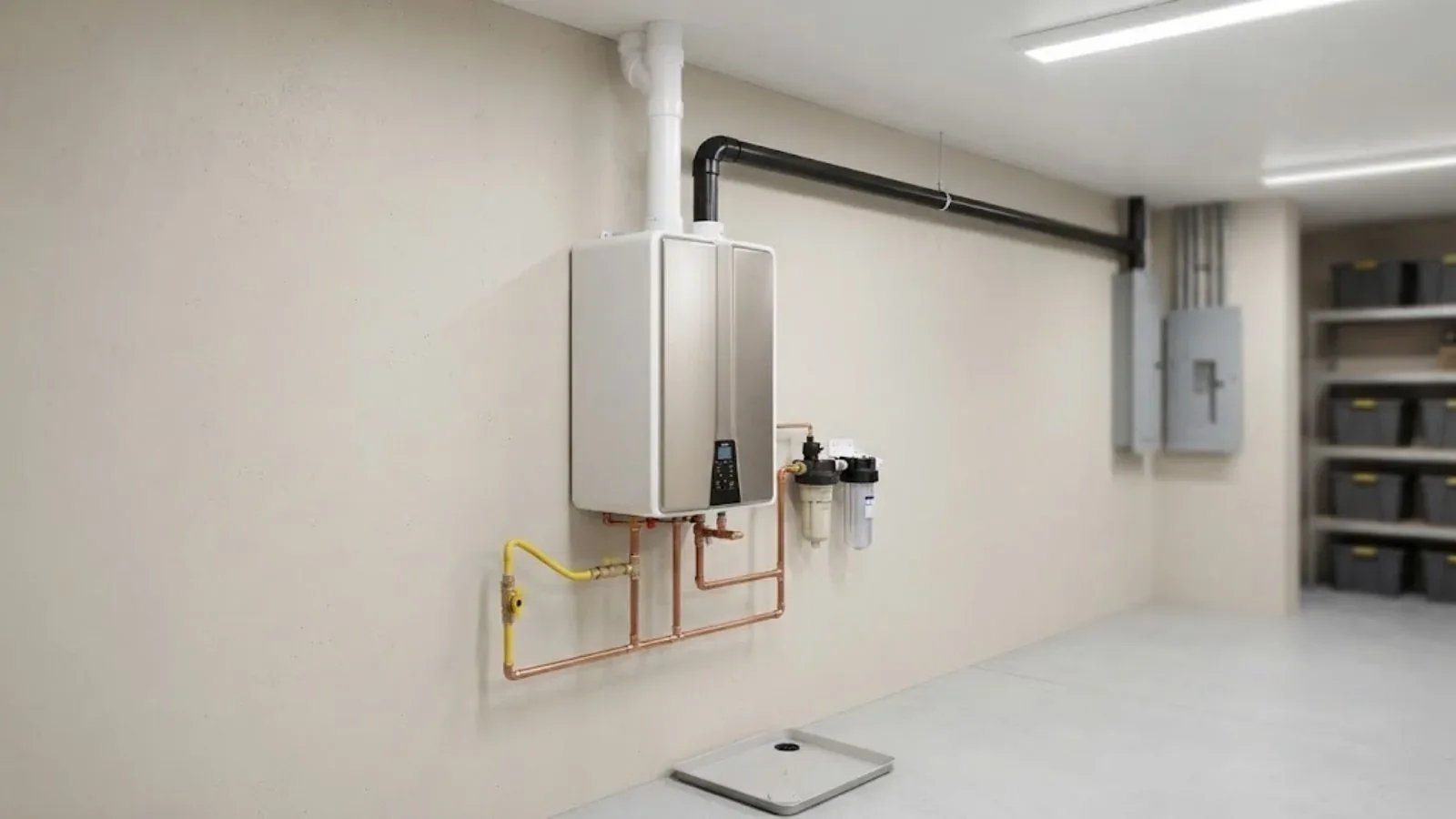
The reason is simple. A tankless heater burns a lot of gas in a short burst and needs a sealed, correctly sized vent to carry exhaust outside. A mistake in either place can mean carbon monoxide in the house.
This guide splits the work into what a careful homeowner can do and what needs a licensed plumber. Questions about your own setup? Call (630) 822-9290 and we will talk it through.
What is safe to do yourself
Homeowners can safely handle the research and the upkeep. The unit's manual is the authority, so keep it where you can find it.
| Task | Homeowner DIY? | Why |
|---|---|---|
| Choosing a model and checking space | Yes | No tools or risk involved |
| Cleaning the cold water inlet screen | Often yes | Follow the manual, shut off water first |
| Descaling flush with isolation valves | Often yes | Needs a pump, hoses and the manual's steps |
| Setting temperature at the unit | Yes | Use the controls as designed |
| Gas line sizing and connection | No | Leak and explosion risk |
| Venting and combustion air | No | Carbon monoxide risk |
| Electrical connection and condensate | No | Shock and drain risks |
| Permit and final inspection | Ask the Village | Rules apply to the work |
If a task is in the "No" rows, stop. Those are the steps where being almost right is not good enough.
Why gas and venting are not DIY
A tankless unit often needs a larger gas line than the tank heater it replaces. If the pipe is too small, the unit starves and shuts down, or runs poorly. If a fitting leaks, you may not smell it until the problem is serious.
Venting is the other half. High-efficiency units often use plastic vent pipe, and the joints, slope and termination matter. A leaking joint puts exhaust gas into the house.
The manufacturer's installation instructions are the standard for a gas tankless unit, and the Illinois Plumbing Code (77 Ill. Adm. Code 890) governs the piping around it. A hookup that departs from them can be refused at inspection.
If you ever smell gas, leave the building immediately. Call Nicor Gas or 911 from outside, and do not flip switches or use a phone inside. Then call us at (630) 822-9290 once everyone is safe.
Cleaning the inlet screen
Most tankless heaters have a small filter screen where cold water enters. Debris can block it and reduce hot water flow, so many people see weak hot water before they see anything else.
Check your manual for where the screen is and how to reach it. Turn off the water supply to the unit, relieve pressure as the manual describes, and remove the screen. Rinse it, put it back, and open the water slowly. If the manual says to call a pro for this step, believe it. Call (630) 822-9290
Flushing scale from a tankless heater
Scale builds on the heat exchanger over time, and the manufacturer usually recommends periodic descaling. A flush uses a small pump, two hoses and a cleaning solution circulated through the unit via service valves.
This is where many homeowners get into trouble. Units without isolation valves need them added first, and the flush must follow the manual's solution and time. A wrong step can leave acid in your plumbing or damage the exchanger.
If you do flush it yourself, rinse thoroughly and run hot water until it is clear. If the unit shows an error code afterward, do not keep resetting it. Our tankless water heater page explains the service side.
Planning a swap from a tank heater
Think about the whole system before you buy. The questions below decide whether a tankless unit fits your house.
- Is the gas line big enough for the unit's input rating?
- Where will it vent, and is there a clear route outside?
- Is there a nearby drain for condensate, if the unit makes it?
- Is there a power outlet within reach?
- Do you have enough hot water demand to justify it?
A plumber can answer these on site. Moving from a tank to tankless is a bigger change than a tank-for-tank swap, which is why our water heater installation page treats it as an install, not a simple exchange.
Permit and rebate facts for Hoffman Estates
The Village of Hoffman Estates lists a $50 fee for a water heater and requires a final inspection, with no same-day inspections. The Village handout lists conditions such as a cold supply shut-off within 5 feet, listed flexible connectors and manufacturer clearances. Confirm current rules with Code Enforcement at 847-781-2631 before you start.
Nicor Gas, the gas utility for Hoffman Estates, lists a $150 rebate in 2026 for a whole-home tankless unit with a UEF of 0.95 or higher and 75 MBTUH or less. Install it between January 1 and December 31, 2026, and apply within 90 days or by January 31, 2027, at apply.nicorgasrebates.com or 877-886-4239. Check your model against those numbers before buying.
Why the permit matters on a tankless job
A DIY install without a permit leaves you with unverified gas and vent work behind a wall. If something goes wrong, an insurer or a future buyer may ask whether the work was inspected. The permit is how you get a second pair of eyes on it.
The Village fee schedule also lists a plumbing permit of $75 plus $10 per fixture for plumbing work. Whether a tankless conversion falls under the water heater fee or the plumbing fee is something to ask Code Enforcement. We do not want to guess here.
What to watch for after a tankless install
Even a good install needs a short checklist at first.
After the unit is running
- No gas smell at the unit or in the room
- No error codes on the display
- Hot water reaches faucets in a reasonable time
- No drips at the connections or the condensate line
- Exhaust vent joints are tight and unobstructed
If you see an error code, check the manual before resetting. Repeated resets without finding the cause can hide a real fault.
When to call a plumber
Call a plumber for the gas connection, the venting, the electrical work and the permit paperwork. Call for a unit that shows error codes, cuts out, or smells like gas or exhaust. If you are unsure whether a job is within your skill, that is your answer.
We are licensed and insured, and we can explain what a tankless install involves before work starts. Call (630) 822-9290 and we will go through the options, including how the install differs from a tank unit. We also serve nearby towns, and the Schaumburg area page shows the neighbouring coverage.
In most homes, no. The gas line, venting and combustion air are safety-critical, and a mistake can cause a gas leak or carbon monoxide. Maintenance such as cleaning the inlet screen is a reasonable DIY task.
Nicor Gas lists $150 in 2026 for a whole-home tankless heater with a UEF of 0.95 or higher and 75 MBTUH or less. Apply within 90 days of install or by January 31, 2027.
The Village lists a water heater permit with a $50 fee and a final inspection. Confirm how a tankless conversion is classified by calling Code Enforcement at 847-781-2631.
Many homeowners do it when the unit has service valves. Follow the manual exactly, and call a plumber if the unit lacks isolation valves or shows errors afterward.
A clogged inlet screen, scale or a gas supply that is too small are common causes. A plumber can check the gas line and the unit.