
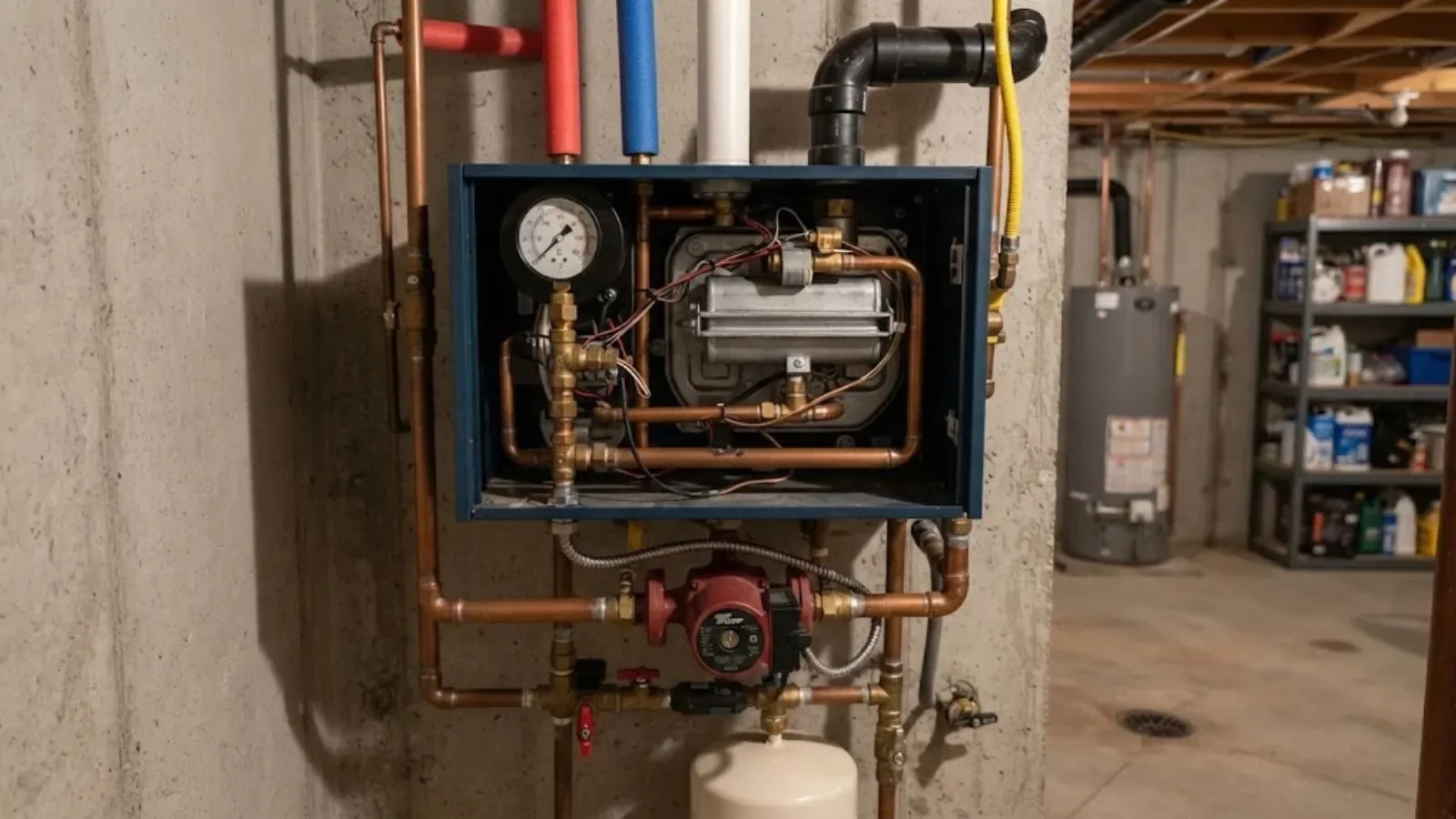
Do these first, in this order
A boiler leak is a plumbing problem, a heating problem and sometimes a safety problem. The goal in the first few minutes is to limit water and stay safe, not to fix it.
First steps
- Switch the boiler off at its on/off switch or thermostat. Do not reach into the unit.
- If water is near the boiler, stay out of it and do not stand in a wet floor near any outlet.
- Close the water supply (fill) valve on the pipe going into the boiler, if it is dry and easy to reach.
- Put a bucket and towels under the drip and note where it comes from.
- Take a clear photo of the leak, the pressure gauge and the label on the boiler.
- Keep the boiler off until a licensed plumber has looked at it.
Do not run the boiler to "see if it stops." A leaking boiler can lose water, drop pressure and overheat. It can also corrode the parts around it.
If you smell gas or have a CO alarm
Gas smell, a hissing sound near the boiler, or a carbon monoxide alarm means leave the house now with everyone. Do not turn lights or switches on or off. From outside, call 911 and Nicor Gas, the gas utility for Hoffman Estates. Then call (630) 822-9290.
Where boilers usually leak
Not every drip means the boiler is finished. The location of the water tells a lot.
| Where the water is | Common cause | Can you act on it? |
|---|---|---|
| Pipe joints or valves nearby | Loose fitting or worn packing | Shut off, call a plumber |
| Pressure relief valve outlet | Pressure or temperature too high | Do not cap it, call right away |
| Under the boiler body | Failed seal or corroded section | Turn off, call a plumber |
| Radiator or baseboard valve | Worn valve stem or packing | Place a bucket, call |
| Expansion tank | Failed tank or bladder | Turn off, call |
| Condensate line (high-efficiency units) | Clogged drain or trap | Call a plumber |
Never plug or cap a relief valve. It is the safety release. If it is dripping, the boiler is telling you pressure or heat is too high. Leave that to a professional.
Our boiler repair page describes the kinds of leaks we look at. A slow drip at a valve is often a smaller repair than a seeping boiler body.
What not to do
Do not tighten or loosen fittings on gas lines, burners or the boiler itself. Do not open the sealed cabinet. Do not add stop-leak products without checking the manual or asking a pro, because they can clog small passages.
Do not keep topping off the water without a reason. A boiler that needs constant water has a leak somewhere, and each refill brings in fresh oxygen that speeds up corrosion. Also, adding cold water to a very hot boiler can crack parts.
Do not ignore a small puddle. Water under a boiler can run along a floor to a drain, an outlet or a stored box. A slow leak can go for weeks before you see it.
Gas, electrical and internal boiler work belong to licensed trades. We will not tell you to do those yourself, and you should not take advice that says otherwise.
The standard for a boiler repair is the manufacturer's service instructions, plus the Illinois Plumbing Code (77 Ill. Adm. Code 890) for the water piping and relief valve. A fix that ignores them can hide the real leak.
Why winter makes leaks show up
Cold winters and your Nicor Gas boiler
The Village code for Hoffman Estates lists an outdoor winter design temperature of minus 10 F, and the National Weather Service normals for O'Hare put the January average low near 18.8 F. Most boilers run hard for months in that kind of cold. Heat cycles stress joints, valves and seals, which is why small weeping leaks tend to show up in the heating season.
For homes on gas, Nicor Gas is the gas utility named on the Village's utilities page.
If you ever smell gas near the boiler, the Nicor line and 911 come before any plumber. The Village has also adopted the 2021 International Fuel Gas Code and International Mechanical Code, which cover gas appliance work. In practice, that means a boiler is not a weekend project, and the person who services it should be licensed. Verify any plumber's Illinois license through the state's IDPH verification page before they start.
What a plumber will check
A plumber starts with the location of the water. They look at the pressure gauge, the relief valve, the expansion tank and the piping around the boiler. They check fittings and valves for weeping and look for rust trails.
If the leak is at a pipe joint or valve, the fix may be a repack or a replacement of that part. If the heat exchanger or a boiler section is leaking, repair is usually not practical and the talk turns to replacement. A technician will explain which path fits before work starts.
Pricing is quoted by phone before work starts, and the final scope depends on the part, access and boiler type. Call (630) 822-9290 with your boiler's make and a photo of the label, and we can ask the right questions.
When a leak is not the boiler
Water near the boiler is not always the boiler. A leaking water heater, a sweating cold pipe or a drain line can look the same. A damp ceiling below a radiator may be a supply line or a pipe in the wall.
If the boiler is dry and the water keeps appearing, the source is somewhere else. Our leak detection service can trace water that does not have an obvious start. A burst or frozen section needs fast action, and our burst pipe repair page covers that.
When to call a plumber
Call a plumber right away when:
- Water is pooling or spraying, not just dripping.
- The pressure gauge is high, or the relief valve is discharging.
- You hear banging, hissing or bubbling from the boiler.
- Heat has stopped and the house is getting cold.
- There is rust, staining or a crusted white buildup around a joint.
- You are not sure where the water is coming from.
If you live in Schaumburg, see our Schaumburg plumbing page for coverage. We handle the plumbing side of boiler leaks day and night. Call (630) 822-9290 and tell us what you see.
Treat it as urgent. Turn it off, keep the area dry, and call a plumber. Gas smell, a CO alarm or water near electricity means leave the building and call 911 and Nicor Gas first.
No. A small leak can grow, and low water can damage the boiler. Leave it off until a licensed plumber checks it.
The Village's utilities page names Nicor Gas as the gas utility. Call them if you smell gas, along with 911.
We did not verify a boiler permit rule, so ask Village Code Enforcement at 847-781-2631 before any replacement work starts. A licensed plumber will normally handle the paperwork.
It usually means water is going somewhere, such as a slow leak, a failed expansion tank or a weeping valve. Do not keep refilling it. Call for a check.