
Why tankless prices vary so much
Two homes can buy the same tankless unit and end up with very different totals. The unit is one line. The rest of the bill comes from what it takes to make your house accept it.
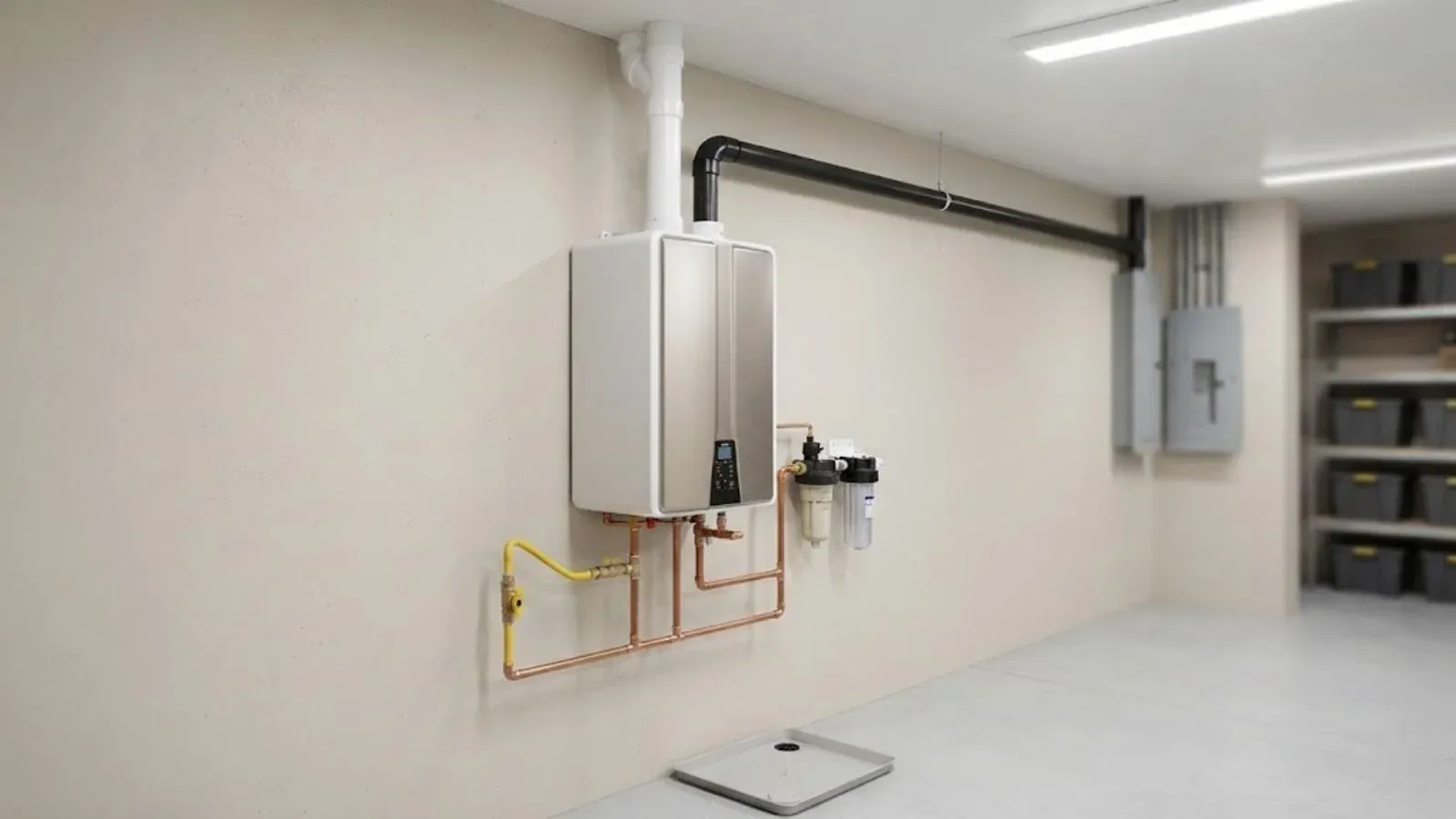
A tank heater sits on the floor with a simple vent. A tankless heater hangs on a wall, burns more gas in a short burst, needs a larger vent, and needs a drain and a condensate path. Each of those changes labor and parts.
So a published average from some other state tells you little. What helps is knowing the factors and asking each contractor to price them one by one. Call (630) 822-9290 and we will walk through them for your address.
| Cost factor | Why it matters | What to ask |
|---|---|---|
| The unit | Capacity and efficiency vary | What flow rate does it deliver in winter? |
| Gas supply | Burners may need a larger line | Is my gas line size enough? |
| Venting | Condensing units use different pipe | Where does the vent exit? |
| Condensate | Acidic water needs a drain path | Where does it drain? |
| Water quality | Scale builds up inside | Do you add isolation valves? |
| Permit | Village inspection required | Is the permit in the quote? |
Sizing the unit for your household
Tankless units are rated by how many gallons per minute they can heat to a set temperature rise. Cold incoming water in winter means a bigger rise, so the same unit delivers less flow in January than in July. Ask for the winter flow number, not the brochure number.
Count what runs at the same time. A shower, a dishwasher and a laundry load at once is a common test. A unit that is too small gives lukewarm water, and one that is too large costs more for capacity you never use.
Tell the plumber how many bathrooms you have and how many people use hot water in the morning. That conversation shapes the model more than any online calculator does.
The gas line and vent are the hidden items
Many tankless units draw far more gas at full fire than the tank they replace. If the existing pipe is too small, a section has to be upsized. That work is done only by a qualified plumber, and you should never adjust gas fittings yourself.
The manufacturer's installation instructions are the standard for the line size, and the work falls under the Illinois Plumbing Code (77 Ill. Adm. Code 890) as the Village adopts it. Ask each bidder which line size those instructions call for, since a bid that skips it is missing a cost.
Venting is the other big variable. Condensing models use plastic vent pipe that runs out a sidewall, and the exit point has to clear windows, meters and walkways. A long run costs more than a short one.
Ask the contractor to show you where the vent will end before you sign. It is easier to move a line on paper than on the siding.
Water quality and long-term upkeep
Minerals form scale on the heat exchanger of any heater. A tankless unit has small passages, so scale can cut flow and trigger error codes sooner than you would expect. Yearly flushing is a normal part of ownership.
Ask whether service valves are installed so the unit can be flushed without cutting pipes. It is a small addition that saves labor every year.
We cannot give you a hardness number for the Village supply. The Village's 2025 water quality report does not print one, so test your own tap with a kit or ask the water provider. Need an upkeep plan? Call (630) 822-9290 and ask about flushing.
Gas tankless vs electric whole-home units
Electric tankless models skip the vent and gas line, which sounds simpler. They pull heavy current, though, and may need a larger breaker or a new circuit from an electrician. Check your panel capacity before pricing one.
For most Hoffman Estates homes with an existing gas tank, a gas tankless unit is the more common path because the fuel is already there. Your panel and gas line decide the real answer, not a rule of thumb.
Nicor Gas rebate and Village permit
Nicor Gas, the gas utility for Hoffman Estates, lists a $150 rebate in 2026 for a whole-home tankless heater with a UEF of 0.95 or higher and a size of 75 MBTUH or less. It also lists $150 for a power-vented or condensing tank with a UEF of 0.86 or higher.
The unit must be installed between January 1 and December 31, 2026. You apply within 90 days or by January 31, 2027, at apply.nicorgasrebates.com or 877-886-4239. Check the numbers on your model before buying, since a unit just under the efficiency line earns nothing. The Village also requires a water heater permit, listed at $50 on its fee handout, plus an inspection.
Tank or tankless: what you are really comparing
A tankless unit does not keep a reservoir hot, so it avoids standby heat loss. It also tends to last longer when it is flushed on schedule. Those are the usual reasons people pay more up front.
A new tank is simpler and cheaper to install, but it takes floor space and eventually fails. If your current tank is old and leaking, a swap is urgent either way. Our water heater replacement page covers that path.
Questions to ask every contractor
A written scope makes quotes comparable. Ask these before you sign anything.
- Does the price include the permit and the final inspection?
- Is the gas line upsizing, if needed, included or extra?
- What vent material and route will you use?
- Are isolation valves for flushing included?
- What happens to the old tank and its disposal?
If a number comes back much lower than the rest, check what was left out. Call (630) 822-9290 and we will give you a quote by phone before any work starts.
What changes the price
The price is given by phone before the work begins, so there are no surprises on the day. Call (630) 822-9290 with your current heater's age and location.
When to call a plumber
Gas, venting and permits make a tankless install a licensed plumber's job. Do not start it as a weekend project. If your current heater is leaking or the pilot keeps going out, shut off the cold water supply to the heater and call (630) 822-9290.
If you smell gas, leave the building first and call Nicor Gas or 911 from outside. Do not flip switches on your way out.
For repairs on a unit you already own, see tankless water heater service. For a new install on a first-time location, see water heater installation. We also cover Schaumburg next door.
No. The 2026 Nicor Gas rebates listed are for qualifying gas tankless units and gas power-vented or condensing tanks. Heat pump units run on electricity.
Apply within 90 days of installation or by January 31, 2027, whichever applies to your case. Install must fall between January 1 and December 31, 2026.
Often yes, but it needs a wall, a vent path and a drain. We check the location, gas line size and clearance before quoting.
Yes. Hoffman Estates lists a water heater permit with a final inspection, and no same-day inspections are available.
It may leave out the permit, vent work or gas upsizing. Compare the written scopes line by line.