
What "from the outside" actually means
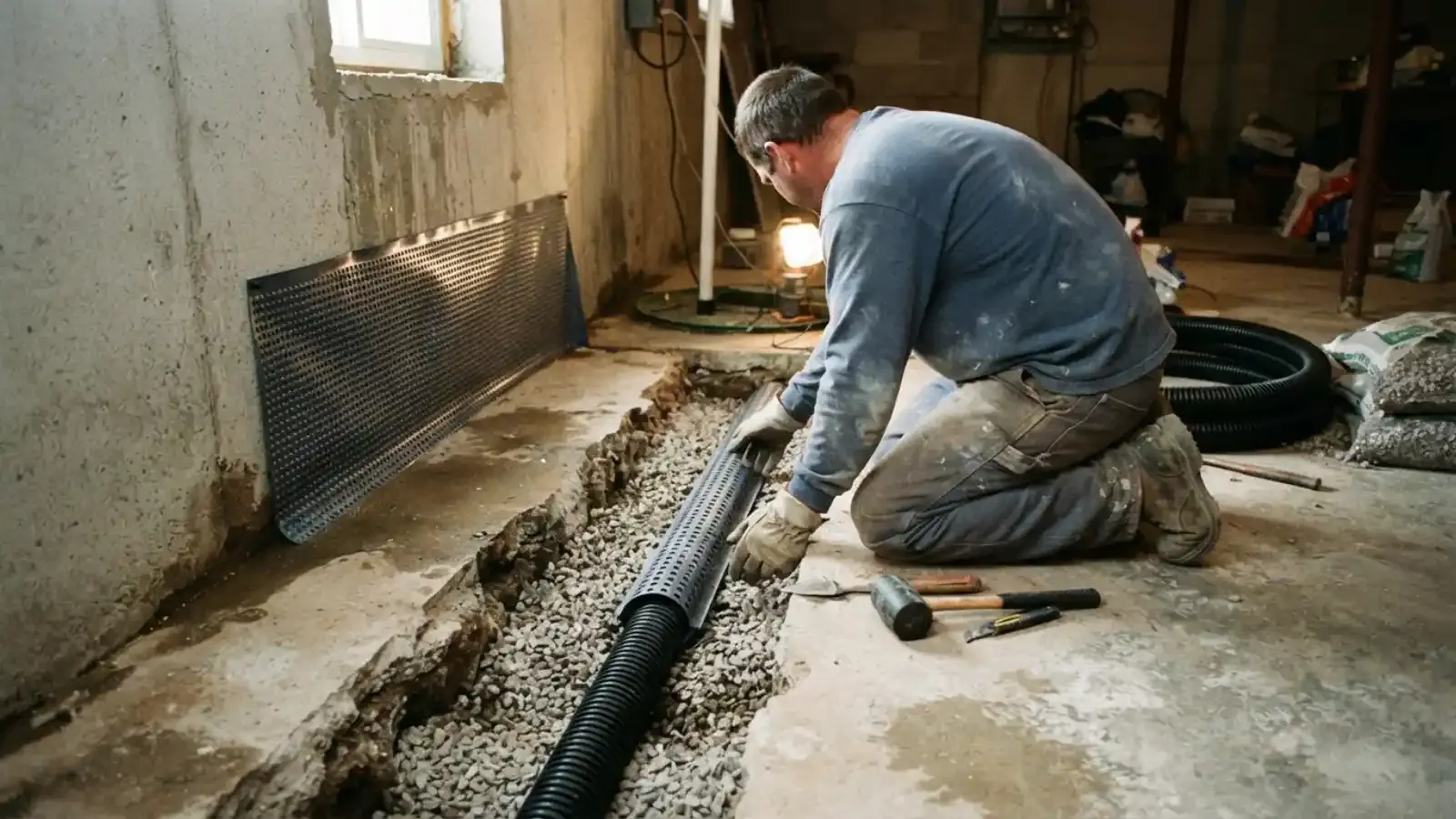
Exterior waterproofing treats the wall before water reaches it. A crew excavates beside the foundation, cleans the wall and applies a waterproof membrane or coating. They then set drain tile at the footing and backfill with gravel.
The goal is to keep water out of the wall and carry it away. Interior systems do the opposite. They catch water after it gets in and move it to a sump pit.
Outside work is the most disruptive option, because it tears up lawn, patios, steps or landscaping beds beside the house. It also takes the longest. That is why it is usually a last resort, after simpler water control has been tried.
| Option | What it does | Fits when |
|---|---|---|
| Fix gutters and grading | Sends roof and yard water away from the wall | Water appears only after storms |
| Interior drain and sump | Catches seepage at the floor edge | Wall cracks are minor, the floor is damp |
| Exterior waterproofing | Seals and drains the outside of the wall | Wall is leaking, access is available |
| Crack repair only | Seals a single active crack | One narrow crack, nothing else |
A contractor who sells basement waterproofing can tell you which row fits. Our basement waterproofing page explains how we approach the plumbing side, including pumps and discharge.
Try these first
Start with the simple, dry-weather steps. Many basement leaks trace back to roof water landing next to the wall.
Free or low-cost checks
- Make sure gutters are clean and downspouts empty at least several feet from the foundation.
- Look at the soil next to the house. It should slope away, not toward the wall.
- Check window wells for debris, standing water and cracked glass.
- Pour a bucket of water into the sump pit and confirm the pump kicks on and empties it.
- Look for wet spots on the wall that line up with a downspout or a hose bib.
- Note whether water shows up only after storms or also in dry weather.
Dry-weather dampness can be a plumbing leak, not a groundwater problem. A pinhole in a supply line or a drip from a drain pipe looks like a wet wall. Our leak detection page covers how that gets found without opening walls.
What the work looks like, step by step
A typical outside job runs in stages. The crew locates the wall problem, digs down to the footing, and cleans the surface. They patch cracks, apply the coating, set drain tile and gravel, and backfill.
Digging is the risky part. Utility lines, water service and gas lines can run near a foundation. The Village's water service handout tells contractors to call J.U.L.I.E. 811 before starting, so the same call belongs ahead of any excavation by you or a hired crew.
Do not rent a trencher and dig along your wall on a weekend. Deep trenches can collapse, and wet clay is heavy. A cracked or moved footing is not a do-it-yourself repair. Leave the dig to a licensed crew.
Drain tile and where the water goes
Drainage rules and frost depth in Hoffman Estates
The Village code (Municode Section 11-3-2) says footing drains and drain tile may not connect to the sanitary sewer. Sump pumps must connect to the storm sewer or discharge to a ditch or swale, and the discharge pipe may not end nearer than 3 feet to the property line. Homes with installations on or after January 1, 1990 are expected to discharge storm water underground to the nearest storm sewer unless the Village Engineer allows another outlet.
That matters in practice because new drain tile has to end somewhere legal. Planning the outlet comes before digging. The Village handout also calls for a minimum 4 inch private pipe, buried 18 inches, with an air gap per the Village detail where a sump or downspout meets underground piping.
Frost depth in the village is 42 inches. Anything buried shallower than that can heave or freeze, so ask any contractor how they handle the outfall in winter. For drainage questions, the Engineering Division at 847-252-5800 handles free drainage investigations.
Municode Section 11-3-2 is the standard a new outlet is judged against, so settle where the water leaves the property before the crew starts digging.
Why the weather matters here
Heavy rain is the usual trigger. The National Weather Service normals for the O'Hare station show about 37.86 inches of precipitation a year. That is the closest NWS station, not Hoffman Estates itself, and local totals can differ.
The Cook County hazard plan lists flooding in Hoffman Estates on October 14, 2017 and several federal flood declarations over the decades. It also notes that multiple areas are prone to flooding. The practical takeaway is simple. A basement that stays dry in a normal year may still need a strong sump system for the wet year.
If your problem is groundwater rising under the slab, outside waterproofing will not solve it alone. You need a sump and a way to move water out.
When to call a plumber
Call a plumber when you see any of the following:
- Water is on the floor now, or the sump pit is overflowing.
- The sump pump runs constantly or does not run at all.
- The pump cycles but water keeps rising.
- You smell sewage or see water coming from a floor drain.
- A wall is bowing, cracking sideways, or shows stair-step cracks.
A bowing wall is a structural issue. Call a foundation or structural contractor too. Keep clear of any flooded area if water touches outlets, a furnace or a panel, and do not walk into standing water. Call (630) 822-9290 and we will talk through safe next steps.
For pumps and discharge, see our sump pump installation and repair page. If you live east of us, the Schaumburg service area page lists what we cover there. Neighboring Schaumburg also has its own footing drain cost-share program, so ask your own village before you spend money.
Questions to ask any waterproofing contractor
Ask where the drain tile will discharge and who approves it. Ask whether permits are included and who pulls them. Ask how they protect the foundation and patios while they dig.
Ask for the plan in writing, with a clear scope. A vague "waterproof the basement" proposal is a warning sign. You can also call (630) 822-9290 to get a plumber's view on the pump and the drain outlet before you sign.
No. The Village code says footing drains and drain tile may not connect to the sanitary sewer. They must go to a storm outlet, a sump system or a ditch as the code allows.
Ask the Village before you start. Code Enforcement at 847-781-2631 can tell you whether your scope needs a permit. The Village drainage handout covers sump and downspout piping, but we do not know of a separate rule for waterproofing alone, so confirm by phone.
The Village code says the discharge extension may not be nearer than 3 feet to the property line and must point toward the ditch or swale. Underground discharge is expected for newer installs.
Sometimes, if the leak is limited to one wall and the drainage is sound. A contractor should look at the whole perimeter, since water finds the weakest spot.
Not always. The sump is still the backup that handles rising groundwater. Plan for both.