
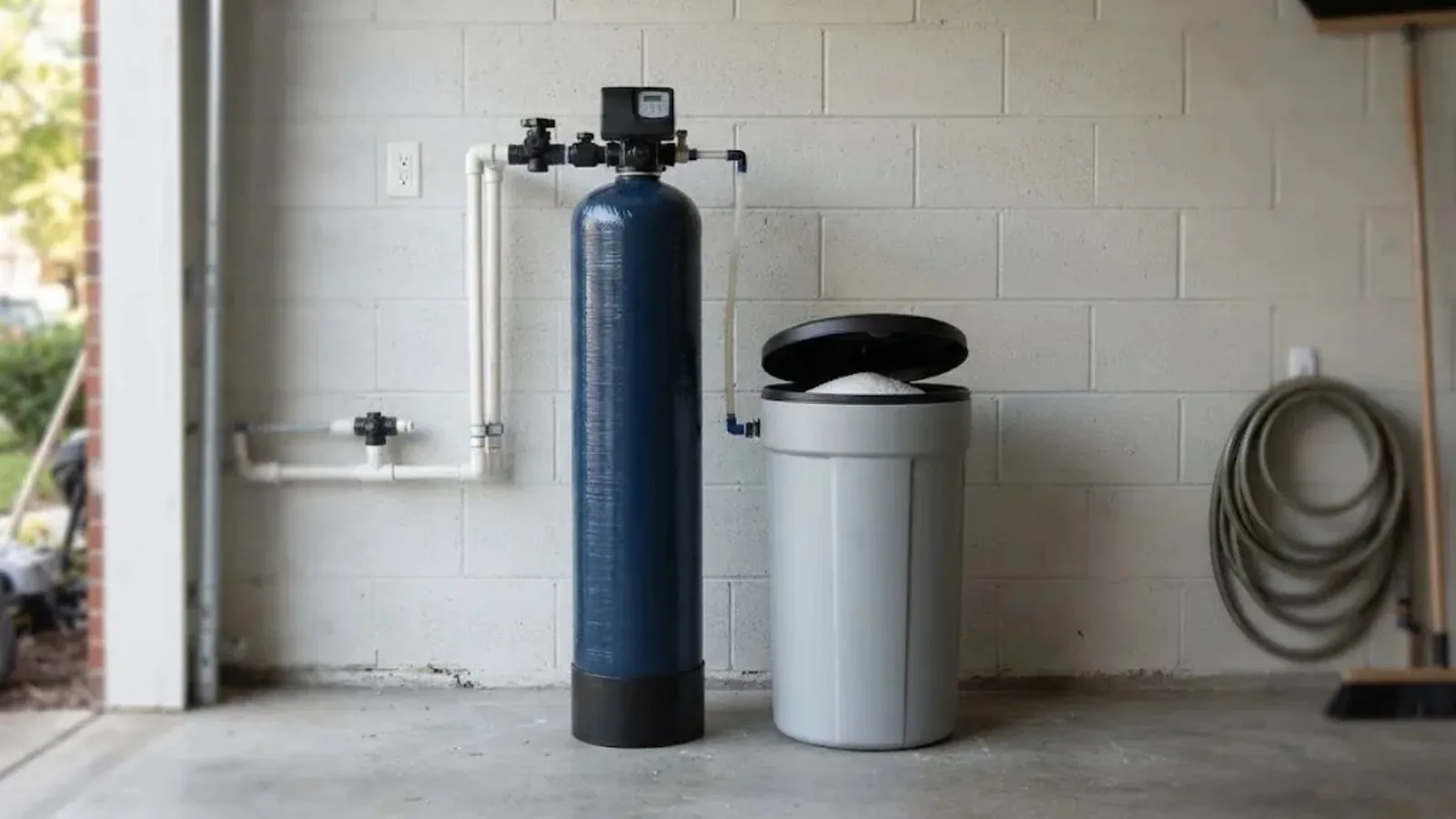
The short answer: on the main line, before the heater
A softener treats water for the whole house, so it belongs close to where the main pipe comes in. In most basements that is near the meter and shutoff, often along a front or side foundation wall.
The unit goes after the main shutoff valve and meter. It goes before the water heater and before the branch lines that feed the rest of the house. That way soft water reaches the shower, sinks, washer and heater.
Placing it before the heater has a practical reason. Hard water scale builds up inside a water heater, so softening the water first protects the tank and its heating parts. Our water heater installation page shows what else sits around a heater.
What the spot needs
A good location has more than a short pipe run. A softener needs a few things nearby, and missing any one of them makes the install harder.
| Need | Why it matters | What to look for |
|---|---|---|
| Main water line | Treats every fixture | Pipe entering the house near the meter |
| Drain | Regeneration flushes brine | Floor drain or laundry standpipe close by |
| Power | Runs the valve head | Standard outlet within cord reach |
| Space | Tank plus a salt bin | Clear area, level floor |
| Freeze protection | Water inside can freeze | Heated basement or utility room |
| Bypass | Lets you service or isolate it | Valve set on the unit |
Garages and unheated utility closets are risky. In Hoffman Estates the Village code uses a frost line depth of 42 inches and an outdoor winter design temperature of minus 10 F. A cold garage can drop below freezing, and a frozen softener can crack. If your only space is unheated, ask about insulation or another location.
Why the outdoor spigots stay untreated
Hose bibs and sprinkler lines should not run on softened water. Lawns and gardens do not need it, and you would be burning through salt for no reason. A plumber ties the softener in after the point where the outside lines branch off.
The same goes for the kitchen cold tap that some people keep for drinking. Softening adds a small amount of sodium. Some households run one unsoftened cold line for drinking and cooking. Ask your plumber during the layout if that matters to you.
Step by step: how a softener gets set
This is a plumbing job with water, electricity and a drain. We do not recommend a DIY install unless you are experienced with soldering, fittings and local code.
How a typical install goes
- Pick the location and confirm drain, outlet and floor space.
- Shut off the main and drain the lines at the work area.
- Cut into the main line and add the inlet and outlet connections and the bypass.
- Run the drain line with an air gap so wastewater cannot siphon back.
- Plug in the head, program the unit, and add salt.
- Open the valves slowly, check each joint for drips, and run a regeneration cycle.
If you have copper, galvanized steel or plastic pipe, each needs the right adapters. Mixing metals can corrode joints. A leak under pressure can soak a finished basement quickly, so double check every joint.
Local water: what we know and do not know
Lake Michigan water in Hoffman Estates
Hoffman Estates buys Lake Michigan surface water from the City of Chicago, and the Village's 2025 Water Quality Report lists it as the sole source since 1985. The report does not print a water hardness figure, and we will not guess one here. The Village lists chlorine, not chloramine, as the disinfectant, at an average of 1.2 parts per million.
What that means for you: do not size or buy a softener from a neighbor's number or an online chart. Test your own tap water with a hardness test kit or lab test, and size the unit from that result. You can also ask the Village Public Works Department about water testing at 847-490-6800.
Permits are the other local step. The Village permit fee handout (effective 2018) lists a $50 fee for a water heater, softener or appliance. Handouts get updated, so confirm with Code Enforcement at 847-781-2631 before you start.
Planning the pipe route
Walk the basement with a flashlight before you pick a spot. Trace the main from the meter and note where it passes the water heater, the laundry area and the first branch lines. The softener's inlet and outlet connect to that main, so the shorter the move, the fewer fittings you need.
Measure the space for the tank, the brine bin and enough elbow room to lift a salt bag. Note whether the floor slopes toward a drain, since the discharge line needs a clear path. A photo of the meter area and the heater helps when you call (630) 822-9290 to talk through the layout.
Where not to put a softener
Avoid tight crawl spaces where you cannot reach the valve head. Avoid spots under a window or near an outside wall that gets very cold. Avoid sites that sit lower than the floor drain, since regeneration water must flow out freely.
Do not set it in a spot with no drain unless a pump setup is planned by a licensed plumber. And do not plumb a softener drain into a sump pit without asking. The Village code says a sump pump is for storm water and an ejector pump is for sanitary sewage. Ask the Village which drain it accepts for the regeneration discharge.
Softener plumbing is held to the Illinois Plumbing Code (77 Ill. Adm. Code 890), and the unit's installation instructions are the standard for the bypass, clearances and drain connection. Settle the drain choice before the tank is set.
Think about the salt, too. Bags weigh 40 pounds or more, so choose a spot where you can carry them without stairs.
When to call a plumber
Call a plumber if any of these apply:
- You need to cut into the main water line.
- Your pipes are galvanized steel, old copper or mixed metals.
- There is no drain near the location.
- The softener has to go in the garage or another cold space.
- The unit leaks, runs constantly or does not regenerate.
- You are replacing an old softener and the fittings have seized.
A plumber can also check your water pressure and see if the unit needs a bypass setup. Our plumbing installation page covers the work around fittings and connections. We also cover water softener and filtration service for existing units. Call (630) 822-9290 and describe your basement layout.
If you live in Schaumburg, our Schaumburg plumbing page lists the same services there. Schaumburg water also comes from Lake Michigan via Chicago, but its village report has no hardness figure either, so test your own tap there too.
Only if the garage is heated or the unit is protected from freezing. Winters here are cold enough that an unheated garage can freeze a softener. A basement utility area is safer.
Before. The softener should treat water on its way to the heater, so scale does not build up inside the tank.
Its 2025 Water Quality Report does not print a hardness number. Test your tap water and size the unit from that result.
Ask first. The Village code says a sump pump handles storm water. Ask the Village or a licensed plumber which drain is allowed for the discharge.
The Village fee handout lists a permit fee for softeners. Confirm the current rule with Code Enforcement at 847-781-2631 before work starts.